
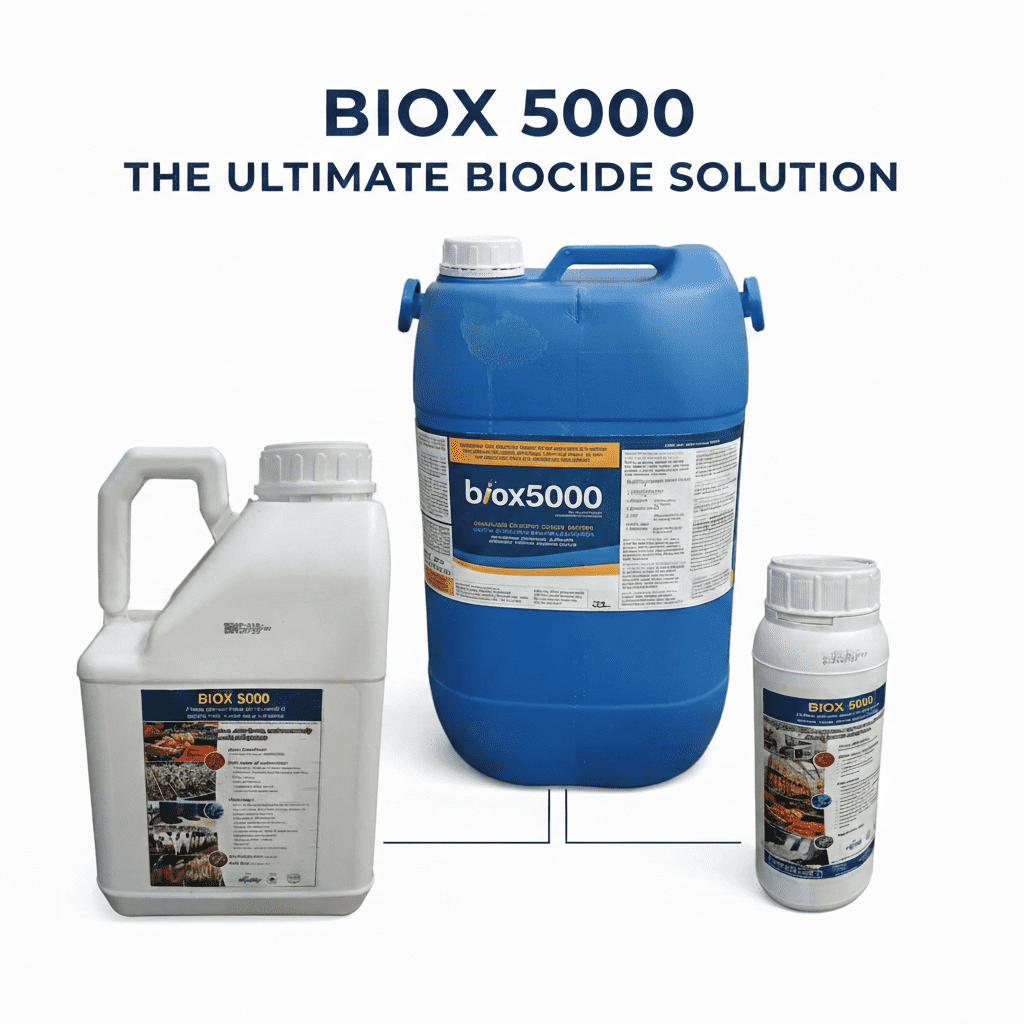
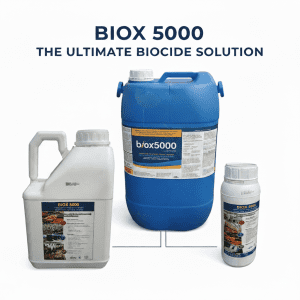
BIOX 5000: Advanced Stabilized Chlorine Dioxide Biocide
BIOX 5000 is a technologically advanced, stabilized chlorine dioxide formulation. It functions as a pure solubilized gas in solution, ensuring high-level disinfection without leaving chemical residues on products or surfaces. While it contains the word “chlorine,” it possesses none of the harmful characteristics associated with traditional chlorine.
Broad-Spectrum Biocidal Activity
This powerful solution serves as a comprehensive sanitizer and removal agent, targeting a wide array of pathogens:
-
Sanitization: Bactericide, fungicide, algaecide, sporacide, and viricide.
-
Biofilm Control: Effectively removes biological films in water lines and dripper systems.
Application Guidelines and Dosage
BIOX 5000 is versatile, suitable for agricultural, horticultural, and food-processing environments.
| Application Category | Recommended Dosage / Dilution |
| Hard Surface Sanitization | 2% solution (2L per 100L water) |
| Soil Sanitization | 50L per 500L water per hectare (Apply late afternoon to pre-wet soil) |
| Seedlings & Cuttings | 0.3% drench (15L per 5,000L water per 2,000 sq.m) |
| Foliar Spray | 0.5% solution (5L per 1,000L water per hectare) |
| Hydroponics (Maintenance) | 0.2% solution (2L per 1,000L water) |
| Post-Harvest Rinsing | 0.2% solution (2L per 1,000L water) |
| Nursery Water (Shock) | 0.4% solution (4L per 1,000L water) |
| Bulbs, Corms & Seeds | 0.4% solution prior to storage |
Technical Specifications & Compatibility
-
Activation: To activate 25L of BIOX 5000, add 775ml of Activator P, mix thoroughly, and allow to stand for 18 hours.
-
pH Range: Stable and effective across a broad pH range ($2 – 12$); requires no pH adjustors.
-
Spray Pressure: Maintain spray pressure below 6 bar.
-
Wetting Agents: Compatible with wetting/spreading agents containing Glycols or Alcohols (typical dose: 10–20 ml/100L).
Chemical Incompatibility (Do Not Mix)
Never mix BIOX 5000 directly with other chemicals or nutrients. It is highly reactive with:
-
Nitrogen Compounds, Iron, Manganese, and Nickel.
-
Sulphides, Carbohydrates, Phenols, and Aldehydes.
-
Secondary and Tertiary Amines.
Irrigation & Dripper System Biofilm Removal
To calculate the volume required to flood a system, use the formula for a cylinder:
Where $d$ is pipe diameter and $L$ is total pipe length.
-
Shock Treatment: Use 2–3L per 1,000L of water. Flood the system overnight and drain the following morning. Repeat three times in the first week.
-
Maintenance: Use 1–2L per 1,000L of water weekly or fortnightly as required.
Regulatory Compliance
-
EPA Registered: Registration number 9150-2.
-
Food Safety: Complies with SABS 1853 for disinfectants used in the food industry.
-
Global Standards: Euro Gap compliant (Reg. Nr. Wet 5GNR529/271983/070/0083).





Reviews
There are no reviews yet